
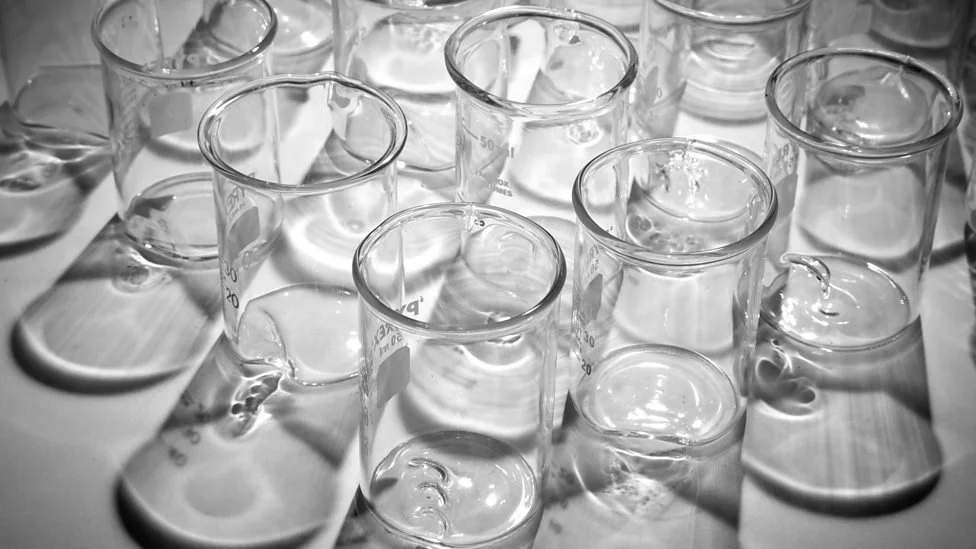
Image courtesy of McFarland & Singer
FAQ
Frequently Asked Questions
Follow the links below to learn more about the History of Glass, how we use it at Firebat, and how you can care for the Glass we provide.
About Glass
When was Glass invented?
The circumstances which surround the invention of glass are somewhat obscure.
Primitive tools such as knives, arrowheads and spears chipped from natural volcanic glass (obsidian) appear to have been used throughout most of the last five hundred centuries.
At least 3,500 years ago, Egyptian and Mesopotamian potters discovered how to produce glass in the form of a glaze which was a mixture of sand and minerals fused onto their stone objects in an oven. They discovered that if this glaze was thick enough it would stand by itself as a glass. By 1,500BC, mankind was producing glass beads, jewels and small containers.
How is Glass made?
Glass is obtained by mixing inorganic chemicals and materials together at high temperatures.
Is Glass a liquid or a Solid?
Yes. Yes it is.
Glass is an amorphous solid, or if you prefer, a kinetically frozen liquid at standard pressure and temperature.
What’s the difference between Glassblowing and Lampworking?
Most people are familiar with the term Glassblowing, the art of taking a blob of molten glass from a furnace and manipulating it using air blown through a long metal tube (known as a ‘blow pipe’ or ‘blow tube’), to form a bubble.
Lampworkers (also often referred to as Glassblowers or Glassworkers) use small precision instruments, such as Bench or Hand Burners, to manipulate glass on a smaller scale, which makes it ideal for intricate work.
What we do at Firebat
What sort of glass do you use?
The glass most frequently used nowadays for general laboratory ware and equipment is the borosilicate glass sold under the brand names of PYREX (from the American company, Corning) and DURAN (from the German company, Schott).
Borosilicate glass is relatively chemically inert, which is why it is used for most scientific applications.
Firebat Glass recycles and reuses Borosilicate glass for both Ornamental and Scientific Purposes.
How does Glassblowing work?
The work done at Firebat is mostly Lampwork.
A mixture of Propane and Oxygen is passed through a Bench Burner to heat glass rods or vessels at the desired point of manipulation. A small rubber blowpipe is attached to the piece and the glassblower uses their breath to keep pressure inside the glass, to prevent it becoming misshapen. Carbon tools are then used to bend or shape the heated glass as required, which is then ‘annealed’ in a extremely hot oven, to reduce stress on the newly formed joints.
Particularly large work can be done using a specialised Lathe with its own attached hand torches.
We do not currently offer training or hands-on experiences, however, as an endangered Heritage Craft, we are exceptionally keen to contribute to keeping the art and science of Glassblowing alive.
Once we are more fully established, we’ll be looking to publish instructional videos on our Youtube channel, and eventually hope to offer more direct tuition to those interested. Watch this space and our socials for more details!
Can I try Glassblowing?
Caring for your glass
Glass can be incredibly strong, but also exceptionally fragile. Mechanical shocks and extreme temperature changes can cause glass to crack and break. All our glass is annealed to strengthen it, but we appreciate accidents happen, so we’re always happy to discuss repairs or replacements, should you experience a breakage.
For storing or transporting glass, we recommend loosely wrapping in bubble wrap, foam or a soft cloth, then placing in an appropriately sized container with loose packing material - the glass should be supported, but not restricted.
Cleaning glass is straightforward - simply wash in warm water, with dish soap and a non-abrasive cloth, then dry immediately with a soft microfibre cloth to prevent water spots.